
EMC’s reaction to Federal Budget 2026
November 5, 2026
Electric Mobility Canada (EMC) welcomes several investments in Budget 2026 that could advance Canada's electric mobility transition, including significant new funding for EV charging infrastructure. The priority now is to turn this commitment into reliable, accessible charging for Canadians across the country.
Federal Budget 2026: Charging investment must deliver for Canadians
Electric Mobility Canada (EMC) welcomes Budget 2026’s $587 million investment over five years to install more than 55,000 electric vehicle chargers in public locations and multi-unit residential buildings. Renewed funding through ECCC’s ZEVIP program is an important step toward expanding charging access, attracting private capital and, especially, providing program predictability. The priority now is to turn this commitment into reliable, accessible charging for Canadians across the country.
Beyond supporting EV adoption, charging infrastructure is an investment in Canada’s economy and a driver of local job creation. Building and maintaining a reliable network supports jobs in electrical trades, construction, charging equipment manufacturing, software and energy services. Targeted federal support can also unlock private investment and create employment opportunities in communities where the market alone is unlikely to deliver the charging Canadians need.
To realize these benefits, investment must reach the communities that need it most. EMC urges the government to prioritize underserved, rural, remote and Indigenous communities; charging near local businesses, community amenities and tourism destinations; and battery energy storage where grid constraints or connection delays prevent deployment.
Equally important is access to charging at home for Canadians living in apartments and condominiums. EMC has recommended that federal retrofit funding cover up to 50% of the costs of electrical upgrades, installation, load management systems and charging stations. Addressing these barriersSuch funding would make electric mobility accessible to more households, rather than only those with a private driveway.
Alongside these charging investments, Budget 2026 proposes $2.2 million over five years, starting in 2027-28, to renew the Greening Government Operations Fleet Program. The program conducts readiness assessments to help the federal fleet transition to zero-emission vehicles.
Budget 2026 proposes $2.2 million over five years, starting in 2027-28, to renew the Greening Government Operations Fleet Program. The program conducts readiness assessments to help the federal fleet transition to zero-emission vehicles.
EMC also welcomes $45 million over five years, starting in 2027-28, for charging infrastructure research and development through NRCan.
On infrastructure delivery, Budget 2026 notes that projects responsibility for thepreviously under the Canada Infrastructure Bank (CIB) will move to the Minister of Finance. EMC looks forward to seeing whether this change improves efficiency.
Beyond charging infrastructure, Budget 2026 addresses the electricity system that will support growing demand. It proposes nearly $4 billion over 10 years, starting in 2027-28, to expand electricity infrastructure, renewable energy and priority electricity sector projects across Canada, including new funding for the Smart Renewables and Electrification Pathways Program.
To support planning for electricity transmission connections, the budget also proposes $37 million in 2027-28 for cost-benefit analysis of proposed interties and discussions on how to share costs across borders.
Complementing this work, Budget 2026 proposes $26.4 million over 10 years, on a cash basis, for Natural Resources Canada to strengthen data and modelling capacity, improve system planning and guide investments where they will be most beneficial.
On the regulatory side, the budget proposes $22.9 million over five years for Environment and Climate Change Canada to update the Clean Electricity Regulations and develop equivalency agreements with provinces and territories where appropriate.
More broadly, Budget 2026 identifies support for electric vehicle battery manufacturing, clean economy investment tax credits and the Canada Public Transit Fund as drivers of planned capital investment. Delivering these measures alongside expanded charging access will be important to advancing Canada’s electric mobility transition.
However, infrastructure investment must be matched by strong, predictable policy. EMC is disappointed by the federal government’s October 21 announcement that the light-duty vehicle greenhouse gas emissions standard will remain flat at 2026 levels through model year 2029, with annual tightening resuming only in 2030. Delaying stronger standards risks weakening the market signal needed to support EV adoption and investment across the vehicle, charging, electricity and battery supply chains. EMC continues to call for a strong, sovereign Canadian standard that delivers steady progress and long-term investment certainty. Infrastructure funding and durable market signals should work together to support Canadian jobs and competitiveness.
Other gaps also remain. Budget 2026 makes no mention of the Zero Emission Vehicle Awareness Initiative (ZEVAI) and provides no update on the medium- and heavy-duty vehicle (MHDV) sector. EMC looks forward to further announcements from the federal government in the coming months.
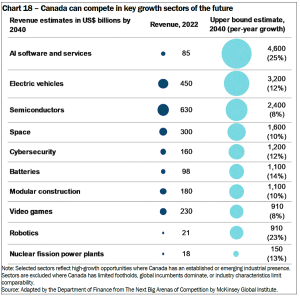
Despite these gaps, Budget 2026’s own projections underscore the opportunity: Chart 18 below ranks EVs second and batteries sixth for forecast growth. The government must now match that potential with sustained support for Canada’s electric mobility and battery sectors.
Ultimately, Budget 2026’s charging investment is a welcome step. Success will be measured by the charging access it delivers, the private investment it unlocks and the communities it reaches. EMC looks forward to working with the federal government and industry to turn these commitments into lasting growth and economic benefits for Canadians.