
Electrifying progress: Energy efficiency in electrified road transportation in British Columbia
June 18, 2026
This report examines how electric transportation efficiency can be improved in British Columbia over the next decade.
EXECUTIVE SUMMARY
British Columbia is a North American leader in transportation electrification, but rapid adoption magnifies the importance of energy efficiency as a system planning issue. Electrification reduces emissions and fuel costs, but it does not, on its own, ensure manageable electricity demand growth or grid compatibility. Vehicle mix, winter performance, charging practices, and travel behaviour all determine whether electrification delivers its full environmental and economic value or creates avoidable pressure on generation, transmission, and local distribution networks.
This report examines how electric transportation efficiency can be improved in British Columbia over the next decade. It assesses vehicle-side technologies, behavioural practices, micromobility, charging infrastructure, and emerging vehicle-to-grid capabilities, and evaluates their implications for electricity demand, coincident peak load, and infrastructure costs. A scenario illustration shows that practical efficiency measures can materially reduce energy use and electricity load under both faster and slower electrification pathways.
The central conclusion is that efficiency must be treated as a core policy objective alongside electrification, particularly given B.C.’s cold climate, growing prevalence of larger vehicles, high share of multifamily housing, and evolving federal policy context. Chapter 4 translates this analysis into a focused set of priority policy levers that can be implemented in the near term, emphasizing those that deliver the largest system value with the highest implementation confidence.
Prioritization matters
Not all efficiency measures deliver the same benefits, and not all are equally feasible or timely. Some reduce annual energy use but do little to address winter peaks. Others offer strong technical potential but depend on long-term behavioural change or future market conditions. British Columbia’s policy and regulatory environment, including BC Hydro’s planning framework and CleanBC governance priorities, favours measures that are predictable, cost-effective, and capable of delivering near-term impacts.
The priority levers identified in this report were assessed against five criteria:
- Magnitude of the efficiency effect enabled
- Ease and speed of implementation
- Short-term impact potential through the late 2020s
- Cost efficiency for government and utilities
- Fit with B.C.’s regulatory, market, and institutional context
Across sectors, the highest-value levers consistently share four characteristics. They lock in efficiency by default rather than relying on voluntary behaviour. They act on vehicles, buildings, or programs entering service now. They reduce coincident peak demand as well as total energy use. And they remain valuable under uncertainty about federal policy direction and future vehicle mix.
Priority policy levers for British Columbia
Lock in vehicle-side efficiency through procurement and information
The single most effective near-term action is to embed efficiency requirements upstream, at the point of vehicle purchase. Provincial and municipal fleet procurement, along with incentive-linked purchases, provide a direct mechanism to require technologies that deliver immediate and durable efficiency gains.
Priority actions include:
- Requiring heat pump HVAC systems, regenerative braking performance disclosure, and low rolling resistance tire specifications in public and funded fleet procurement.
- Introducing winter efficiency disclosure, including winter kWh per 100 km and thermal system configuration, to steer buyers toward grid-friendly vehicle trims without reintroducing purchase rebates.
These measures are particularly important in B.C.’s winter conditions, where HVAC loads and vehicle mass can significantly increase energy use and evening charging demand. They are low-cost to administer, build on established procurement processes, and deliver benefits every time a vehicle is driven and charged.
Scale behavioural efficiency through structured, low-cost programs
Behavioural measures are among the fastest and most cost-effective efficiency tools available. Unlike vehicle turnover, they can be deployed at scale immediately, producing measurable reductions in energy use and charging demand.
Two levers stand out:
- A province-wide EV eco-driving program delivered through the Insurance Corporation of British Columbia (ICBC), employers, municipalities, and fleet operators. Evidence shows eco-driving can reduce EV energy use by 5 to 15 percent for light-duty vehicles and 5 to 10 percent for medium- and heavy-duty vehicles, with corresponding reductions in charging frequency and peak load.
- Fleet efficiency reporting requirements tied to CleanBC and utility funding. Requiring funded fleets to track and report energy intensity embeds efficiency into operational culture, improves grid planning predictability, and helps avoid unmanaged fast charging spikes.
These measures are technology-mix robust. They deliver benefits for battery electric vehicles, plug-in hybrids, and remaining internal combustion vehicles, reducing system risk during a period of policy and market uncertainty.
Micromobility: Reduce electricity demand by avoiding vehicle trips
Micromobility delivers a different efficiency outcome by avoiding vehicle charging altogether. Replacing short car trips with e-bikes or cargo bikes produces energy savings that are orders of magnitude larger than marginal vehicle efficiency improvements, while adding negligible load to the grid.
Priority micromobility levers include:
- Making the provincial e-bike rebate permanent and income-conditioned. Evidence from B.C. shows the program drives new adoption, sustained use, and measurable reductions in car kilometres traveled, particularly for short trips that often trigger evening charging.
- Funding e-cargo bike pilots and micro-depots for last-mile deliveries in dense urban areas. These programs reduce van kilometres, ease depot charging requirements, and deliver congestion and air quality co-benefits.
From a power system perspective, micromobility is a unique efficiency lever because it directly suppresses electricity demand growth from transportation rather than reshaping it.
Manage charging to reduce peaks and defer infrastructure upgrades
Where and when charging occurs is often more important for grid outcomes than how many vehicles are electrified. Unmanaged evening charging in single-family homes, coincident charging in multifamily buildings, and end-of-shift depot charging can all create localized stress that outpaces average load growth.
Three charging-related levers are foundational:
- A province-wide EV-ready requirement for new residential construction, including detached homes and multifamily buildings. Ensuring panel capacity, conduit, and network-ready equipment at construction avoids costly retrofits and enables managed charging at scale. EV-ready should include smart and efficient chargers by default, so new load is controllable, not just connectable.
- Residential managed charging programs with default overnight scheduling. These programs can shift 40 to 70 percent of home charging to off-peak hours, delivering immediate and measurable peak reduction aligned with BC Hydro’s demand-side management objectives.
- Depot interconnection fast-tracking tied to managed charging commitments. Prioritizing projects that demonstrate controllable load reduces over-sizing, accelerates fleet electrification, and protects local distribution assets.
Together, these measures improve utilization of existing infrastructure and defer the need for upgrades driven primarily by charging coincidence rather than total energy demand.
Take a measured, enabling approach to V2X
Vehicle-to-grid and related applications offer long-term flexibility potential, but near-term value lies in preparation rather than broad deployment. The highest priority actions are enabling rather than capital-intensive.
Near-term focus should be on:
- Clarifying regulatory pathways for V2G energy exports, including compensation mechanisms and interconnection standards.
- Piloting V2H and depot-based V2G in strategic public and commercial fleets where duty cycles and charging behaviour are predictable.
This approach builds B.C.-specific evidence and readiness without exposing ratepayers to premature risk.
Implications for electricity planning and policy
The scenario analysis in this report shows that combining electrification with practical efficiency measures can reduce cumulative electricity demand by roughly 17 to 18 per cent over the next decade compared to electrification alone, equivalent to tens of terawatt-hours of avoided load. More importantly for BC Hydro, these measures materially reduce winter peaks and defer distribution and feeder upgrades.
The priority policy levers identified here align closely with BC Hydro’s emphasis on demand-side resources and CleanBC’s focus on cost containment, equity, and system resilience. Implemented together, they form a coherent efficiency backbone that supports transportation electrification while controlling grid impacts and preserving affordability.
The overarching conclusion is clear. Early action on high-value efficiency levers is not optional. It is a prerequisite for delivering an affordable, reliable, and resilient electrified transportation system in British Columbia.
Simulation
The graph below shows one of our simulations: A basic energy efficiency package applied to BC Hydro’s published light‑duty EV electricity load forecast. Relative to the BC Hydro baseline, the simulation implies about 18.4 TWh of cumulative electricity demand that can be avoided. By 2050, the avoided annual load is approximately 1.5 TWh. Other simulations are presented in the full report.
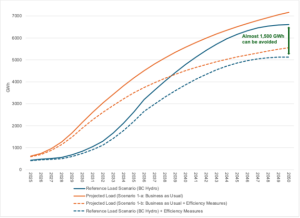
Load of ZEV Passenger cars and trucks, Business as Usual, with and without efficiency measures (EMC Calculations)